

AI search didn’t break SEO. Bad assumptions did.
Over the last 12 months, “AI SEO” advice has exploded. Most of it sounds confident. Much of it is incomplete—or flat wrong. If you are following the standard playbook of “more content, more prompts, more FAQs,” you aren’t just wasting time; you are becoming invisible to the very systems you’re trying to reach.
Here are the five biggest mistakes currently dominating AI SEO guidance, and the architectural shifts that actually matter.
1. The “Intent” Myth: It Didn’t Disappear, It Moved Upstream
The Bad Advice: “Search intent doesn’t matter anymore—AI just answers everything instantly.”
Intent hasn’t vanished; it has been compressed. In the old world, a user would perform five different searches to navigate the funnel. Today, they have one long-form conversation with a chatbot.
AI systems like Google’s Gemini or Perplexity still rely on Intent Classification and Query Expansion. They are just doing the heavy lifting behind the scenes.
Stop mapping content to isolated keywords. Map it to the Decision Journey:
- Exploration: Provide the frameworks and definitions the AI needs to build the user’s foundation.
- Evaluation: Offer the tradeoffs and constraints that help an AI compare you to competitors.
- Decision: Provide the “Proof Points”—case studies and specific data—that give the AI the confidence to cite you as the final answer.
2. The Attribution Trap: Traffic is the Wrong Metric
The Bad Advice: “If AI doesn’t send a click to my site, the visibility is worthless.”
This is the most damaging belief in marketing right now. It is a measurement failure, not a distribution failure. AI influence creates a “Dark Funnel” effect. The journey now looks like this:
- AI Interaction: User researches a problem and the AI mentions your brand.
- Trust Formation: The user validates that mention via a direct brand search.
- Conversion: The user hits your site and buys.
Your analytics will credit “Direct” or “Organic Brand” for that sale. If you only look at referral traffic from ChatGPT, you’ll think you’re failing while your revenue is actually growing because of AI citations.
3. Structure is Not Design; It’s Legibility
The Bad Advice: “Just use bullet points and short paragraphs to make it ‘AI-friendly.’”
Modern retrieval systems—specifically those using RAG (Retrieval-Augmented Generation)—don’t “read” your page. They chunk it. They break your 2,000-word article into small semantic blocks (usually 300–500 tokens) and score those fragments independently.
If your key insight requires a human to read the intro, middle, and conclusion to understand it, the AI will miss it.
What matters instead: Think in Retrieval Units. Every section of your page should be “atomic.” It must:
- Stand alone without needing the rest of the page for context.
- Explicitly declare its subject (No “As mentioned above” or “This results in…”).
- Contain a complete, high-density answer that an LLM can lift and drop into a summary.
4. The “Natural Language” Delusion
The Bad Advice: “Keywords are dead. Just write naturally and the AI will figure it out.”
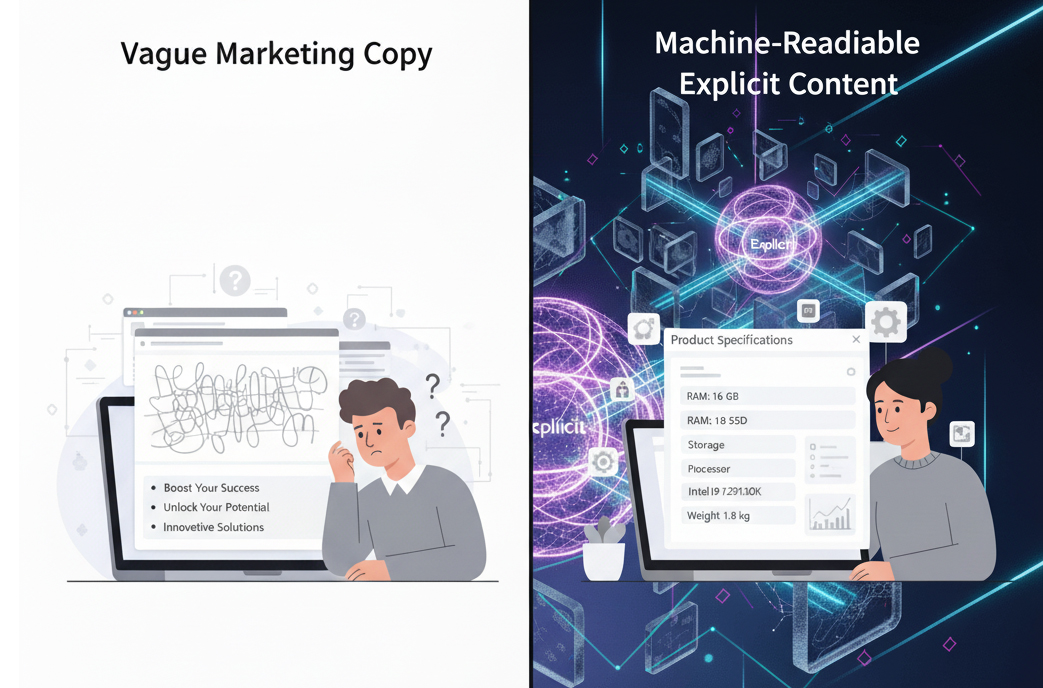
This is dangerous because “natural” often translates to “vague.” AI models are probabilistic, not psychic. While keyword stuffing is dead, semantic precision is more important than ever. AI systems struggle with poetic ambiguity or “fluff” marketing speak.
Write like an engineer, not a copywriter.
- Name the Entity: Don’t say “our solution,” say “The [Brand Name] ERP Framework.”
- Define the Relationship: Clearly state how your service relates to the user’s problem.
- State Constraints: “Ideal for SMBs under $50M” is a signal; “Great for everyone” is noise.
5. The Content Volume Fallacy
The Bad Advice: “To win at AI SEO, you need to publish five AI-generated posts a day.”
AI visibility is rarely blocked by a lack of content. It is almost always blocked by Entity Chaos. AI search engines are risk-averse; they don’t want to hallucinate or recommend a “shaky” source.
If your LinkedIn says one thing, your website says another, and your Schema markup is broken, the AI sees a “Trust Gap.” It doesn’t matter how much content you publish; if the machine can’t verify who you are and what you’re an expert in, you will be skipped.
Fix the Entity before the content:
- Is your NAP (Name, Address, Phone) data consistent across the web?
- Do you have “Person Schema” or “Organization Schema” that explicitly links your experts to their credentials?
- Is your brand identity a clean, machine-readable footprint?
The Real Shift: From Ranking to Recognition
Most AI SEO advice fails because it treats AI like just another Google algorithm update. It isn’t. It’s a new Decision Intermediary.
The winners of 2026 won’t be the loudest publishers. They’ll be the clearest sources—the brands that AI can confidently quote without second-guessing their authority.
If your strategy is “write better content in a new format,” you’re already behind. Stop optimizing for the click. Start optimizing for Extractability.