

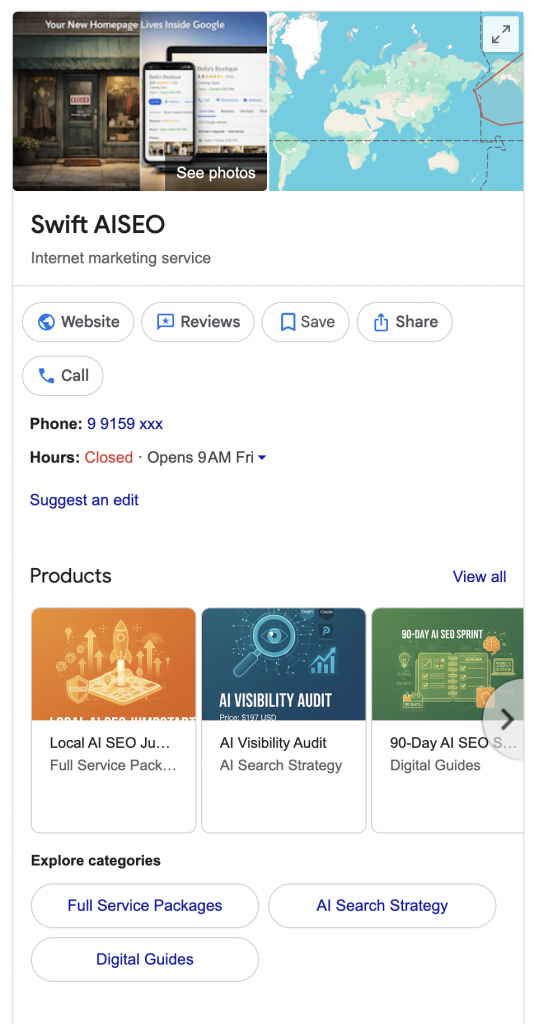
Why is the digital billboard model dead in local search?
The digital billboard model failed because AI systems evaluate structured data for certainty, not visuals or slogans meant for humans.
For twenty years, the “Digital Billboard” model of marketing dominated local discovery. You bought space, added a polished image, wrote a slogan about “unparalleled service,” and waited for a human to notice.
In 2026, that model is no longer just outdated; it is a liability.
Your Google Business Profile (GBP) is not built for people. It is built for machines. Specifically, it functions as a structured data feed for Google Gemini and the AI-driven version of Maps. These systems act as the ultimate intermediaries between businesses and customers. They do not “browse” profiles; they evaluate risk and certainty.
If your data is clear, you are included in the AI answer. If it is ambiguous, you are ignored. This is the era of Answer Engine Optimization (AEO), and it begins with treating your GBP as a database, not a brochure.
What is Google Business Profile (GBP)?
Google Business Profile is Google’s verified business database that AI systems use to evaluate trust, relevance, and safety before recommendations.
To the AI, your profile is a collection of entities and relationships. It doesn’t see a “Great Plumber”; it sees an “Entity” categorized as [Plumbing Contractor] with “Relationships” to [Emergency Service] and [Zip Code 78701].
How do AI systems decide which local business to recommend?
AI systems recommend local businesses based on certainty, calculated from profile completeness, data consistency, and recent activity signals.
Certainty is built on three pillars:
- Completeness: Did you answer every question the profile asked?
- Consistency: Does your data on Google match your data on Yelp, Bing, and your own footer?
- Recency: Is there “Proof of Life” in the last 7 days?
A business with 50 reviews but current photos and 100% complete attributes will outrank a “legendary” local shop with 1,000 reviews that hasn’t updated its hours since 2022. The AI would rather give a “safe” answer than a “popular” one that might be wrong. Missing data signals abandonment.
Why do GBP attributes determine AI visibility?
GBP attributes act as binary filters that AI systems use to instantly include or exclude businesses from high-intent local searches.
Think of attributes like:
- Same-day service
- Emergency service
- Wheelchair accessible
- Accepts credit cards
When a user says, “Find me a vet that is open late and takes Apple Pay,” Gemini does not read your “About” section to see if you mention Apple Pay. It checks the Attribute Field. If that field is empty, the system assumes the answer is “No.” You are excluded before the “ranking” even begins. Attributes determine survival in long-tail, high-intent searches.
How should services be written for AI discovery?
Services should be written using invoice-level nouns and verbs so AI systems can accurately categorize and match businesses to queries.
- The “Brochure” Style (Fail): “We offer a curated automotive experience for discerning drivers who demand the best.”
- The “AI-Ready” Style (Win): “Automotive repair shop providing oil changes, brake pad replacement, and engine diagnostics.”
The second version uses “Invoice-Level Terminology.” It matches the exact words a user says and the exact words Gemini uses to categorize businesses. Clear language enables accurate entity matching. Adjectives create noise that lowers the AI’s confidence.
How do reviews train AI systems to trust a business?
AI systems analyze review text to verify that real customer experiences match a business’s listed services, locations, and claims.
If your profile lists “Transmission Repair,” but your last 50 reviews only mention “Oil Changes,” Gemini’s confidence in your ability to fix a transmission drops.
The Practitioner’s Secret: You need “Service-Narrative” reviews. Don’t just ask for five stars. Ask customers to mention what they bought and where they are. A review that says, “Best residential roofer in Plano; they fixed my hail damage in two days,” is a massive trust signal for three different AI filters: [Service], [Location], and [Speed].
How do photos affect AI trust in local businesses?
AI systems analyze business photos to verify location, equipment, and legitimacy, using real imagery as proof that an entity is active.
Every photo you upload is processed by Google Vision AI. It isn’t just looking at the “quality” of the photo; it is identifying objects to verify your entity.
AI identifies:
- Exterior Signage: Confirms your business name and physical location.
- Equipment/Tools: Confirms you actually do the work you claim (e.g., seeing a lift in a mechanic’s shop).
- Branded Assets: Seeing your logo on a truck or a shirt.

Stock imagery contributes zero trust. In fact, it can be a “De-ranking” signal because it suggests the business is a lead-gen scam or a “Ghost” entity. Real, raw photos are “Proof of Life.”
Why does NAP consistency affect AI inclusion?
Consistent name, address, and phone data allows AI systems to resolve a business entity with confidence and avoid exclusion errors.
If your profile says “Main St.” but your Facebook says “Main Street,” or your old website lists a disconnected phone number, the AI experiences Reconciliation Friction.
When an AI is confused, it gets “scared” of making a bad recommendation. A consistent NAP footprint allows the AI to “resolve” your entity with 100% confidence. Inconsistency leads to exclusion.
Why does AI favor inclusion over rankings?
AI prioritizes inclusion over ranking position, selecting the business that best satisfies specific user constraints rather than traditional popularity signals.
In the old world of SEO, we obsessed over being #1. In the world of AI, the objective is Inclusion.
Gemini’s AI summaries often cite businesses that aren’t in the top three map positions. Why? Because that business was the only one that matched a specific user constraint (like “Veteran-owned” or “Same-day”).
The goal is to be the named answer in the AI’s summary. You don’t win that by “gaming” keywords; you win it by having the most granular, factual data set in your market.
How does AI determine if a business is still active?
AI systems assess business activity using recent photos, posts, and owner responses to determine whether profile data is stale or reliable.
Owner Responses are your best tool for reinforcement. When you respond to a review, use it to repeat your data: “Thanks for the review, Sarah! We love providing [Service] to the [City] community.” This signals to the AI that the entity is still active and the services are still being performed.
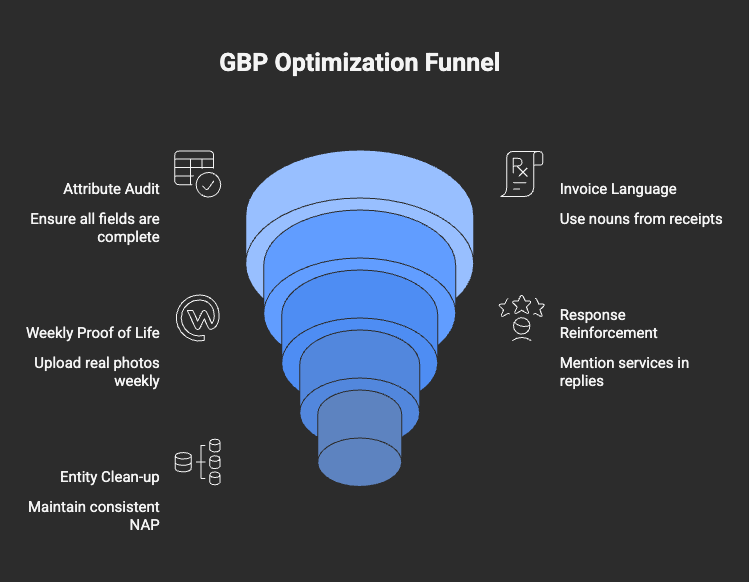
GBP Optimization in Practice: The 2026 Checklist
To dominate local AI results, move away from marketing and toward Data Management:
- Attribute Audit: Fill every field, even the ones that seem minor.
- Invoice Language: Describe services using the nouns found on your receipts.
- Weekly Proof of Life: Upload one real photo of a job site or staff member every week.
- Response Reinforcement: Mention the specific service in every review reply.
- Entity Clean-up: Ensure your NAP is identical across every digital touchpoint.
Final Takeaway
Google Business Profile is no longer a marketing asset. It is a Data Management System.
Businesses that maintain clean, granular, and verified data become the “Trusted Inputs” for AI-driven discovery. Those that rely on slogans and stock photos are excluded by default. In 2026, local visibility belongs to the entities with the highest Certainty.
Stop writing for people. Start feeding the machine.