


AI SEO writing is not about using AI to write blogs faster.
That idea peaked years ago, alongside NFT projects and growth hacks that stopped working the moment everyone copied them.
AI SEO writing is the discipline of creating content that AI-powered search systems can retrieve, understand, and confidently cite when answering real user questions.
This means writing for:
- Google AI Overviews
- ChatGPT and Perplexity citations
- Conversational and voice search
- Any system that generates answers instead of returning links
This guide explains what AI SEO writing actually is, how it differs from traditional SEO copywriting, and how to structure content so it survives the shift from rankings to answers.
Why this change matters:
AI systems select sources before they generate answers. If your content is not retrieval-ready, it is invisible no matter how well it once ranked.
What Is AI SEO Writing?
AI SEO writing creates content structured so AI systems can retrieve, understand, and cite it when generating answers.
Instead of optimizing for blue links and click-through rates, you’re optimizing so AI engines can:
- Find your content when searching for sources to answer a question
- Understand your content without ambiguity or inference
- Use your content safely in synthesized answers
- Cite your content as a trusted source
In practical terms: your content is written so machines can extract and reuse facts without hallucinating, paraphrasing them into nonsense, or skipping you entirely.
What makes content AI-optimized for citation?
AI-optimized content is clear, entity-aligned, fact-stable, and structured so individual statements can stand alone as answers.
Effective AI SEO writing is:
- Semantically clear – Written in plain, direct language that AI systems can parse without guessing
- Entity-aligned – Clearly connected to identifiable people, businesses, places, or concepts
- Fact-stable – Contains verifiable information that doesn’t change meaning when extracted
- Answer-ready – Structured so individual statements can stand alone as complete answers
If your content meets these criteria, you’ve moved beyond traditional SEO into the answer layer of search.

Why does traditional SEO writing fail in AI search?
Traditional SEO fails in AI search because AI engines retrieve sources before ranking and prefer clear, factual, low-ambiguity content.
Traditional SEO writing was built on three assumptions:
- Rankings equal visibility
- Keywords equal relevance
- Traffic equals success
AI search breaks all three.
Here’s how AI systems actually work:
- They select sources before ranking anything (retrieval happens first)
- They prefer structured, factual, low-ambiguity language over narrative content
- They generate answers users never click away from (zero-click is the default, not the exception)
If your content is vague, bloated with fluff, or relies on clever synonyms and pronoun chains, it doesn’t get penalized.
It gets ignored.
Which is worse.
What does AI-citation-ready content look like in practice?
Traditional SEO approach (Estate Attorney):
“When you’re thinking about your family’s future and considering the complex landscape of estate planning options, our experienced team of dedicated legal professionals is here to guide you through every step of the process with compassion and expertise…”
AI SEO approach (Estate Attorney):
“Miller & Associates Estate Law serves clients in Cook County, Illinois. Attorney Sarah Miller specializes in wills, trusts, probate, and estate administration. Licensed in Illinois since 2008. Practice areas include revocable living trusts, pour-over wills, healthcare directives, and probate litigation.”
Traditional SEO approach (Med Spa):
“Discover the transformative power of our cutting-edge aesthetic treatments designed to help you look and feel your absolute best with our range of innovative solutions…”
AI SEO approach (Med Spa):
“Radiance Med Spa offers Botox, dermal fillers, laser hair removal, and chemical peels in Scottsdale, Arizona. Licensed medical director: Dr. Jennifer Wong, MD. Services performed by certified nurse practitioners and licensed aestheticians. Arizona medical spa license #MS-2847.”
Traditional SEO approach (HVAC):
“Looking for exceptional heating and cooling services in your area? Our experienced team of certified technicians has been providing top-quality solutions to homeowners throughout the greater metropolitan region…”
AI SEO approach (HVAC):
“Mile High Mechanical provides residential HVAC repair and installation in Denver, Colorado. Services include furnace repair, air conditioning installation, duct cleaning, and 24/7 emergency heating service. Licensed and insured since 2003. Service area covers Denver County and surrounding areas within 25 miles.”
Traditional SEO approach (Title Company):
“As your trusted partner in one of life’s most important transactions, we bring decades of combined experience to ensure a smooth and worry-free closing process…”
AI SEO approach (Title Company):
“Cornerstone Title Company provides title insurance, escrow services, and closing coordination in Orange County, California. Services include title searches, lien resolution, 1031 exchange facilitation, and mobile notary. Licensed California escrow company since 1997.”
Notice the pattern: entity name, location, specific services, credentials, and geographic scope, all stated clearly in the first paragraph.
That’s citation-ready content.
How do you write content AI systems can cite?
AI-citable content answers questions directly, anchors to clear entities, avoids ambiguity, and presents facts in extractable blocks.
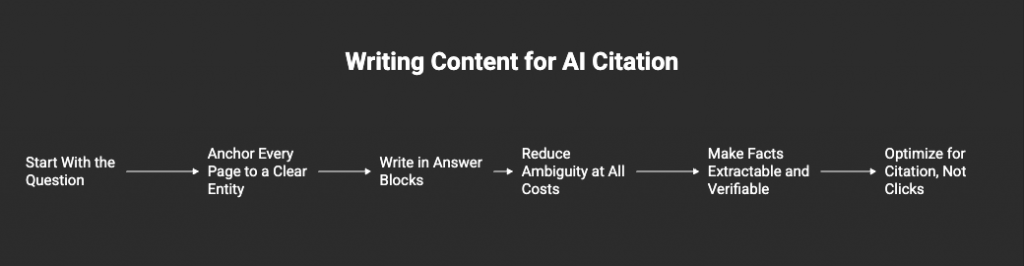
1. Start With the Question, Not the Keyword
AI systems retrieve content based on questions and intent, not exact-match phrases.
This means:
- Identify the actual questions your audience asks
- Answer those questions directly in the first 1-2 sentences
- State your conclusion early, then provide supporting detail
- Avoid narrative buildup before delivering facts
Estate Attorney Example:
Instead of: “Many people wonder about the complex legal instruments available for protecting their assets and ensuring their wishes are carried out…”
Write: “A revocable living trust in Illinois allows you to avoid probate, maintain privacy, and control asset distribution after death. Unlike a will, a living trust takes effect immediately and can manage assets if you become incapacitated.”
Med Spa Example:
Instead of: “One of the most common questions we receive from clients concerns the duration of results for popular anti-aging treatments…”
Write: “Botox results typically last 3-4 months. Dermal fillers last 6-18 months depending on the product used. Both require maintenance treatments to sustain results.”
2. Anchor Every Page to a Clear Entity
AI systems need to know:
- Who this content is about (person, business, organization)
- What service, product, or topic is being addressed
- Where this applies (geographic relevance if applicable)
- How you connect to related topics and entities
Title Company Example:
Every service page should open with entity clarity:
“Cornerstone Title Company provides 1031 exchange facilitation for investment property owners in Orange County, California. Our exchange coordinators handle qualified intermediary services, timeline management, and IRS compliance documentation for like-kind exchanges under IRC Section 1031.”
This tells AI systems:
- Entity: Cornerstone Title Company
- Service: 1031 exchange facilitation
- Audience: investment property owners
- Location: Orange County, California
- Authority: specific technical expertise
HVAC Example:
“Mile High Mechanical installs high-efficiency furnaces in Denver-area homes. Installation includes equipment removal, new furnace mounting, ductwork connection, thermostat wiring, and city permit coordination. All installers are NATE-certified. Service area includes Denver, Aurora, Lakewood, and Thornton.”
Entity clarity is what allows AI systems to confidently associate your content with local intent and specific service queries.
3. Write in Answer Blocks, Not Paragraph Soup
AI engines extract answers in chunks, not flowing prose.
An “answer block” is a self-contained unit of information that:
- Answers one specific question or addresses one fact
- Can be understood without surrounding context
- Is typically 2-3 sentences or 30-50 words
- Uses clear headers to signal topic boundaries
Structure your content with:
- Descriptive headers (H2, H3) that preview the answer
- Short declarative paragraphs (2-3 sentences max for factual statements)
- Lists, definitions, and scoped explanations
- Minimal transitional language between facts
Estate Attorney Example:
Instead of one long paragraph about trust types, use answer blocks:
What is a revocable living trust?
A revocable living trust is a legal document that transfers ownership of your assets into a trust during your lifetime. You maintain complete control as trustee and can modify or revoke the trust at any time. Upon death, assets pass to beneficiaries without probate.
What is an irrevocable trust?
An irrevocable trust permanently transfers asset ownership and cannot be modified after creation. This trust type offers asset protection from creditors and may reduce estate tax liability. The grantor gives up control in exchange for legal protections.
Each block stands alone. Each can be cited independently.
Test: If you can extract a single paragraph and it still makes complete sense in isolation, you’re doing it right.
4. Reduce Ambiguity at All Costs
Ambiguity is poison for AI retrieval.
Every pronoun is a question mark. Every vague reference is a retrieval failure waiting to happen.
Ambiguity reduction means:
- Naming the subject explicitly instead of using “it,” “they,” or “this”
- Being specific about locations, services, and outcomes
- Repeating key entities naturally instead of using synonyms for variety
- Avoiding jargon unless you define it immediately
Med Spa Example:
Ambiguous: “This treatment is popular with our clients and typically produces visible results within a few days. It’s administered by our trained professionals and usually takes about 15 minutes.”
Clear: “Botox injections at Radiance Med Spa are administered by certified nurse practitioners. Treatment takes 10-15 minutes. Most clients see wrinkle reduction within 3-5 days, with full results visible at 14 days.”
Title Company Example:
Ambiguous: “These services are available throughout the region and can help facilitate various types of transactions for clients who need them.”
Clear: “Cornerstone Title Company provides escrow services for residential and commercial real estate transactions in Orange County. Services include buyer escrow, seller escrow, refinance escrow, and 1031 exchange coordination.”
Clarity beats creativity every single time.
5. Make Facts Extractable and Verifiable
AI systems are trained to avoid hallucination. They prefer content where facts are:
- Stated clearly and completely
- Verifiable through cross-reference
- Consistent with established entity data
- Free of hedging language that creates uncertainty
HVAC Example:
Instead of: “Our prices are generally competitive and we often provide quotes that customers find reasonable for this type of work.”
Write: “Furnace repair service calls start at $89. Typical repairs range from $150-$600 depending on parts and labor. Free estimates provided before any work begins. Emergency service available 24/7 with $149 after-hours fee.”
Estate Attorney Example:
Instead of: “The process usually takes a reasonable amount of time and costs will vary based on your specific situation.”
Write: “Simple will preparation takes 2-3 weeks from initial consultation to execution. Cost ranges from $500-$800 for individual wills, $800-$1,200 for married couples. Revocable living trust packages start at $2,500 and typically take 3-4 weeks to complete.”
Med Spa Example:
Instead of: “Results vary by individual and treatment costs depend on several factors.”
Write: “Botox pricing at Radiance Med Spa: $12 per unit. Most clients need 20-30 units for forehead lines ($240-$360), 10-20 units for crow’s feet ($120-$240). Results last 3-4 months on average. Touch-ups recommended quarterly.”
The less an AI system has to infer, interpret, or guess, the more likely it is to cite you.
6. Optimize for Citation, Not Clicks
This is the hardest mental shift for traditional SEO practitioners.
AI SEO writing assumes:
- The user may never visit your site
- Your value is in being referenced, not clicked
- Visibility comes from being used in answers, not from traffic
This doesn’t mean traffic doesn’t matter. It means traffic follows authority, and authority in AI search is built through:
- Consistent citation in AI-generated answers
- Entity recognition across multiple contexts
- Reinforcement of topical expertise
- Trust signals that AI systems can verify
Real-world scenario (Title Company):
Someone asks ChatGPT or Google: “What does a title company do in a real estate transaction?”
If your content is optimized for citation, the AI might respond:
“A title company conducts title searches to verify property ownership, resolves any liens or claims against the property, provides title insurance to protect buyers and lenders, holds funds in escrow, and coordinates the closing process. According to Cornerstone Title Company, they also facilitate 1031 exchanges and handle disbursement of funds to all parties at closing.”
You didn’t get the click. But you got:
- Brand mention in the answer
- Entity association with title services
- Authority reinforcement for future retrievals
- Visibility to someone who now knows your name
In 6-12 months, the businesses and experts getting cited will be the ones getting discovered. Visibility is shifting from blue links to answer inclusion, and traffic will follow.
How should local industries write for AI search?
Local AI SEO content must clearly state services, locations, credentials, and scope so AI systems can match answers to local intent.
For Estate Attorneys
Focus content on:
- Specific legal instruments (wills, trusts, POAs, healthcare directives)
- State-specific requirements and timelines
- Cost transparency and process clarity
- Credential verification (bar admission, practice areas)
- Jurisdiction precision (county, state)
Key questions to answer:
- Do I need a will or a trust in [State]?
- How much does estate planning cost in [Location]?
- What happens if I die without a will in [State]?
- How long does probate take in [County]?
For Title Companies and Escrow Officers
Focus content on:
- Transaction types you handle (residential, commercial, refinance, 1031)
- Geographic service area (county-level precision)
- Licensing and regulatory compliance
- Timeline and process explanations
- Fee transparency
Key questions to answer:
- What does a title company do during closing?
- How much does title insurance cost in [County]?
- What is a 1031 exchange timeline?
- How long does escrow take in [State]?
For HVAC Contractors
Focus content on:
- Equipment types and brands serviced
- Service area with specific cities listed
- Emergency availability and response times
- Licensing and certification details
- Pricing transparency for common services
Key questions to answer:
- How much does furnace repair cost in [City]?
- How long does AC installation take?
- What size HVAC system do I need for [square footage]?
- Do I need a permit to replace my furnace in [City]?
For Med Spas and Aesthetic Practices
Focus content on:
- Specific treatments offered (Botox, fillers, laser, etc.)
- Provider credentials (MD, NP, RN, licensed aesthetician)
- Results timelines and maintenance schedules
- Pricing per unit/area/session
- Medical oversight and licensing
Key questions to answer:
- How much does Botox cost in [City]?
- How long does [treatment] last?
- What are the side effects of [procedure]?
- Who can legally perform [treatment] in [State]?
What “Search-Optimized” Means in 2026 and Beyond
In AI-driven search, “optimized” content is content that:
- Can be safely reused by an AI engine without introducing errors
- Aligns with known entity data in knowledge graphs and structured databases
- Matches user intent cleanly without requiring contextual inference
- Requires minimal interpretation to extract core facts
If an AI system has to work hard to understand your content, it will use someone else’s instead.
AI SEO Writing vs. AI Content Generation
Before someone gets excited and misses the point:
AI content generation is about using LLMs as production tools to write faster.
AI SEO writing is about creating content optimized for LLM retrieval and citation.
You can absolutely use AI tools to help you write. Many effective AI SEO practitioners do.
But if the output isn’t retrieval-ready and citation-safe, you’ve just produced garbage more efficiently.
The strategy, entity logic, framing, and fact verification must be intentional. Tools assist. Strategy decides what matters.
Where AI SEO Writing Fits in Your Content Strategy
AI SEO writing is most critical for:
- Service and product pages that answer “what do you offer” questions
- Location pages that establish geographic relevance
- FAQ and help content that directly addresses user questions
- Guides and thought leadership that establish topical authority
- Definitional content that AI systems use to understand concepts
It supports:
- Google AI Overview inclusion
- Voice and conversational search results
- LLM-based discovery and research tools
- Featured snippet and answer box eligibility
What it’s not:
- A replacement for technical SEO (site structure, speed, mobile optimization)
- A substitute for authority building (backlinks, brand mentions, expertise signals)
- A magic solution that works without entity clarity or topical depth
AI SEO writing is the layer that makes your content usable by AI systems. It works in conjunction with—not instead of—other SEO fundamentals.
What is the core rule of AI SEO writing?
AI SEO writing is about being understood, not being clever.
If your content:
- Answers real questions clearly
- States facts in extractable blocks
- Reinforces entity identity consistently
- Respects how AI systems retrieve and synthesize information
Then you’re no longer just chasing rankings.
You’re participating in the answer layer of search.
That’s where visibility is going—and the sooner you adapt, the better positioned you’ll be.