

Clearscope vs. Surfer SEO vs. InLinks vs. Semrush
AI search isn’t “coming.” It’s already eating your clients’ traffic.
Google’s AI Overviews, ChatGPT, Gemini, Perplexity, Bing Copilot… they don’t show ten blue links and politely ask users to choose. They generate one answer and sprinkle a handful of citations on top.
Your clients are not paying you to “rank on Page 1” anymore.
They’re paying you to be the answer.
That’s where Answer Engine Optimization (AEO) and the right stack of tools come in.
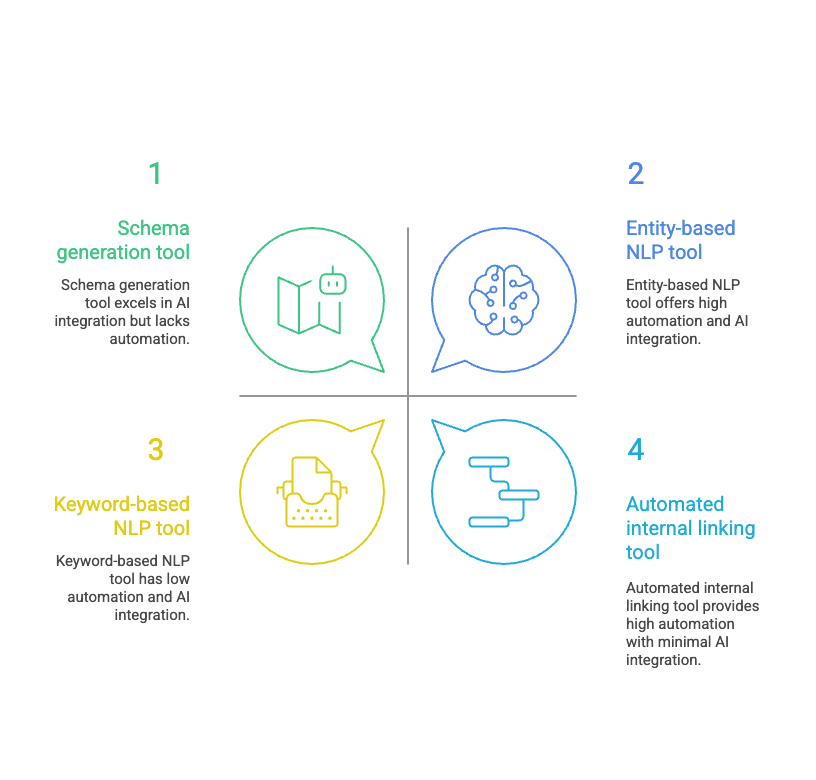
In this guide, we’ll break down the 4 best AEO tools for agencies in 2025:
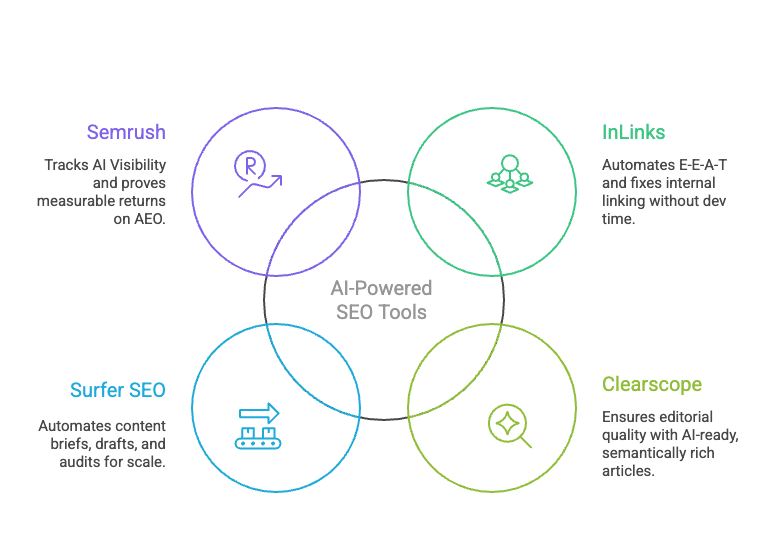
- Clearscope – premium content quality & AI visibility
- Surfer SEO – high-volume AI content & AI tracking
- InLinks – entity-based internal linking & schema automation
- Semrush – all-in-one SEO + AI visibility & competitive intel
You’ll see exactly what each does, where they fit in an AI-first strategy, and how to build a stack that actually makes you money instead of just adding one more SaaS bill.
What AEO Actually Means in 2025
Traditional SEO:
“How do we rank this page for keyword X?”
AEO in 2025:
“When someone asks an AI: ‘Who should I trust for X?’
does it mention our client and cite their site?”
That difference changes how you choose tools and how you show ROI.
AEO isn’t just “use some AI tools”
If you want your clients to get cited by AI systems, you need tools that help you:
- Structure content like answers
Clear questions, direct responses, usable by AI as “answer capsules.” - Strengthen entities, not just keywords
Make it obvious who the business is, what they do, and where they’re trusted. - Automate the boring technical stuff
Internal links, schema, topical clusters – things that are crucial for AI and a nightmare to do manually at scale. - Track AI visibility, not just rankings
“We moved from position 8 to 3” is nice.
“We doubled brand citations in AI answers” is how you look like the only adult in the room.
That’s the lens we’re using as we compare Clearscope, Surfer, InLinks, and Semrush.
How to Choose an AEO Tool as an Agency
Before we get into the tools, here’s the short checklist you should be evaluating them against.
1. Core AEO focus
- Is it keyword-based NLP (classic “cover these terms”)
- Or entity-based / knowledge-graph aware (what the AI actually cares about)?
You want both. But understand where each tool leans.
2. Schema & structured data
- Does it help you generate FAQ / HowTo / Person / Organization schema?
- Can it deploy schema without you hand-editing JSON for every client?
This is the fast lane into rich results and clearer AI understanding.
3. Internal linking & topical architecture
- Does it help build topical clusters and internal links automatically?
- Or is your team still stuck building link maps in spreadsheets at 11pm?
Your internal architecture is your entity graph. Tools that automate this save you a ridiculous amount of time.
4. AI visibility & citation tracking
- Can you see where your client is mentioned by AI?
- Can you compare that to competitors?
- Can you tie that to traffic and leads?
If not, you’re guessing. And clients pay you to stop guessing.
5. Agency pricing & workflow fit
- Per-seat or unlimited users?
- Hard caps on content reports?
- APIs for automation?
- Does this actually fit how your team works?
The best AEO tool is useless if your writers hate it or your strategist can’t get clean reporting out of it.
With that in mind, let’s talk about the tools.
Tool #1 – Clearscope
Best for: Premium content quality & AI-era “discoverability”
Clearscope started as “the content optimizer everyone trusts” and evolved into a discoverability platform built for an AI search world.
What Clearscope does well
- World-class content editor
- Real-time content grades based on semantic coverage and search intent
- Dead simple UI your writers will actually use
- Strong integrations with Google Docs and WordPress
- AI visibility & citation insight
- Reports that show which topics and queries your domain is getting cited for across AI systems
- Lets you see your content not just as “ranking content,” but as training data and citation sources
- Editorial-first workflow
- Avoids “spammy over-optimization”
- Helps you write content that’s easy for humans to read and easy for AI to summarize and trust
When Clearscope is a fit
Use Clearscope if:
- You run a content-heavy agency (blogs, guides, thought leadership)
- Your clients care about premium quality and long-term authority
- You want to train writers once, then let them run without babysitting them in 12 different tools
Clearscope is your “make every article an asset AI wants to quote” engine. It’s not trying to be your rank tracker, link tool, and CRM. It just makes your content unreasonably good.
Tool #2 – Surfer SEO
Best for: High-volume content teams & AI-assisted production
If Clearscope is the meticulous editor in the corner, Surfer is the caffeine-fueled content machine.
What Surfer does well
- AI content generation at scale (Surfer AI)
- Generate first drafts in minutes, pre-optimized based on real SERP data
- Add your brand voice and style so it doesn’t read like a generic chatbot
- Content Score keeps writers grounded instead of wandering off into fluff
- AI Tracker for LLM visibility
- Track whether your brand or pages are being cited in AI answers
- Set up prompts like “best estate planning attorney in [city]” and see who AI keeps naming
- Turn that into a roadmap: “we need a better page + more authority here”
- Workflow fit for agencies
- Clear limits: X content editors, Y AI articles per month – easy to plan
- Good integrations (Docs, WP, etc.)
- Shared workspaces for strategists + writers
When Surfer is a fit
Use Surfer if:
- You’re producing 30+ pieces of content per month across clients
- You need to move fast without sacrificing optimization
- You want a single system to go from keyword → brief → draft → optimized post
- You’re ready to build reporting around “AI mentions” and not just “positions”
Surfer is your AI-powered assembly line. It won’t replace your strategist, but it will remove hours of grunt work per piece.
Tool #3 – InLinks
Best for: Entity SEO, internal linking, and schema on autopilot
Clearscope and Surfer optimize what you write.
InLinks optimizes how your site is understood.
This is your entity + structural AEO engine.
What InLinks does well
- Automated internal linking
- Add one JavaScript snippet
- Tell InLinks what each page is “about”
- It automatically creates contextually relevant internal links across your site
- No more manual “where should we link this?” nightmares
- Automated schema markup
- Generates and injects JSON-LD for:
- “About” / “Mentions” entities
- FAQs
- Other key structured data
- No hand-coding, no “did we paste that wrong?”
- Generates and injects JSON-LD for:
- Entity-based content analysis
- Looks at your content through knowledge-graph eyes
- Highlights which entities are missing or under-covered
- Helps you build true topical authority, not just rank for one keyword and vanish
When InLinks is a fit
Use InLinks if:
- You manage content-heavy sites (blogs, practice areas, service pages, resource hubs)
- Dev time is limited and you can’t rely on engineers to implement SEO changes
- You actually care about topical authority and E-E-A-T, not just stuffing more content into WordPress
InLinks is the infrastructure layer of AEO: internal links that make sense, schema that talks directly to AI systems, and entity coverage that screams:
“This brand knows this topic better than anyone.”
Tool #4 – Semrush
Best for: All-in-one SEO + AI visibility & competitive intelligence
Semrush is the big, heavy artillery.
If you want one platform that covers almost everything, this is it.
What Semrush does well
- AI Visibility Toolkit
- Track how often your brand is mentioned in AI answers
- See which pages AI cites as sources
- Compare AI visibility vs. competitors
- Identify prompt gaps (“AI keeps mentioning Competitor A for this question, never us”)
- Full SEO + content stack
- Keyword research, rank tracking, site audits, link analysis, competitive intel
- Content tools (SEO Writing Assistant, content templates)
- Local, PR, PPC, social – everything in one ecosystem
- AI-powered analytics & strategy
- See traffic from AI channels (e.g. Bing Chat, AI overviews)
- Understand which pieces of content actually move the needle in an AI-search world
- Tie AI visibility back to pipeline and revenue
When Semrush is a fit
Use Semrush if:
- You’re a multi-service agency (SEO, content, PPC, local, PR)
- You need one source of truth for all client search data
- You want to report beyond “rankings and organic traffic” and show:
- AI visibility
- AI referrals
- Competitive AI footprint
Semrush is your AEO command center. It’s heavier, more expensive, and more complex – but if you run a serious operation, it’s the difference between guessing and actually knowing.
Quick Comparison: AEO Features at a Glance
| Tool | Primary Strength | Schema Automation | Internal Linking | AI Visibility Tracking | Best Fit For |
|---|---|---|---|---|---|
| Clearscope | Premium content optimization & AI-ready answers | Manual / template-friendly | Manual (guided by structure) | Yes (AI citation / visibility insights) | Content-led agencies, premium retainers |
| Surfer SEO | High-volume AI-assisted content & audits | Manual / guidelines | Semi-automated (per article) | Yes (AI Tracker add-on) | Agencies scaling content production quickly |
| InLinks | Entity SEO, internal links, schema on autopilot | Fully automated | Fully automated (JS) | Indirect (via improved authority) | Agencies focused on authority & structure |
| Semrush | All-in-one SEO + AI visibility & competition | Manual / via playbooks | Suggested via audits | Yes (full AI visibility toolkit) | Multi-service agencies, in-house marketing teams |
So… Which AEO Stack Should You Actually Use?
You don’t need all four tools on day one.
You need the right combination for your agency model.
1. Content-heavy boutique agency
You:
- Write long-form content, thought leadership, guides
- Serve law firms, medspas, B2B, professional services
- Sell strategy + content, not “we’ll build you 10,000 links”
Recommended stack:
- Clearscope → for briefs & optimization
- InLinks → for internal linking + schema automation
Clearscope makes every piece of content citation-worthy.
InLinks makes your site’s structure and entities AI-friendly.
You instantly look like the grown-up in the room when you tell clients:
“We’re not just chasing rankings. We’re structuring your entire site so AI sees you as the authority.”
2. High-volume content shop / white-label SEO
You:
- Produce dozens of articles per month
- Work with other agencies as a backend content partner
- Care deeply about cost per article and throughput
Recommended stack:
- Surfer SEO (Scale plan) → for briefs, AI drafts, audits
- InLinks (if you manage the sites) → to handle linking & schema
Surfer keeps your production fast and consistent.
InLinks silently fixes the “boring but critical” structural work in the background.
You pitch:
“We can produce content at scale and get it plugged into a clean internal architecture that AI can easily digest.”
3. Full-service digital agency
You:
- Offer SEO, content, PPC, local, maybe social/PR
- Work with bigger budgets and leadership teams
- Need dashboard-level visibility for multiple channels
Recommended stack:
- Semrush One → the hub (SEO + AI visibility + competitive analysis)
- Surfer or Clearscope → the writer-facing optimizer (pick the one that fits your workflow)
- Optional: InLinks → for sites where you want serious entity/structure upgrades
Semrush becomes your source of truth.
You plug in Surfer or Clearscope as your content execution layer.
For high-value clients, you add InLinks and quietly make their entire site more AI-ready than their competitors’.
That’s how you justify:
- Higher retainers
- Longer contracts
- “AI search visibility” as a line item in your proposals
Your Next Step: Tool First or Strategy First?
Here’s the part nobody likes to hear:
AEO tools are accelerants, not strategy.
You don’t start with “Which plan should I buy?”
You start with:
- Which questions do we want AI to answer with our client’s name?
- Which entities do we want them associated with?
- Which pages should be “answer pages” vs. “supporting context”?
Once you know that, the tools stop being shiny objects and start being levers.
Suggested next move
- Map your AEO opportunities for one client
- List 10 high-value questions their ideal customer is asking AI
- Identify which of those questions they already have content for
- Highlight the gaps (no page, weak page, or no structure)
- Test a small AEO stack on that map
- Use Clearscope or Surfer to rewrite/expand one key page
- Use InLinks (or at least manual schema + internal links) to reinforce it
- Use Semrush or Surfer AI Tracker to see if AI starts picking it up
- Turn the result into a case study
- “We got your brand cited X times in AI answers for [topic] in 60 days.”
- Put that in every future proposal.
You don’t need a giant overhaul to start.
You just need one clean AEO win you can point to and say:
“This is what being the answer looks like.
Do you want more of this, or more ‘ranking reports’ nobody reads?”