

AI SEO: What It Is and How It Supports Local AEO in 2026
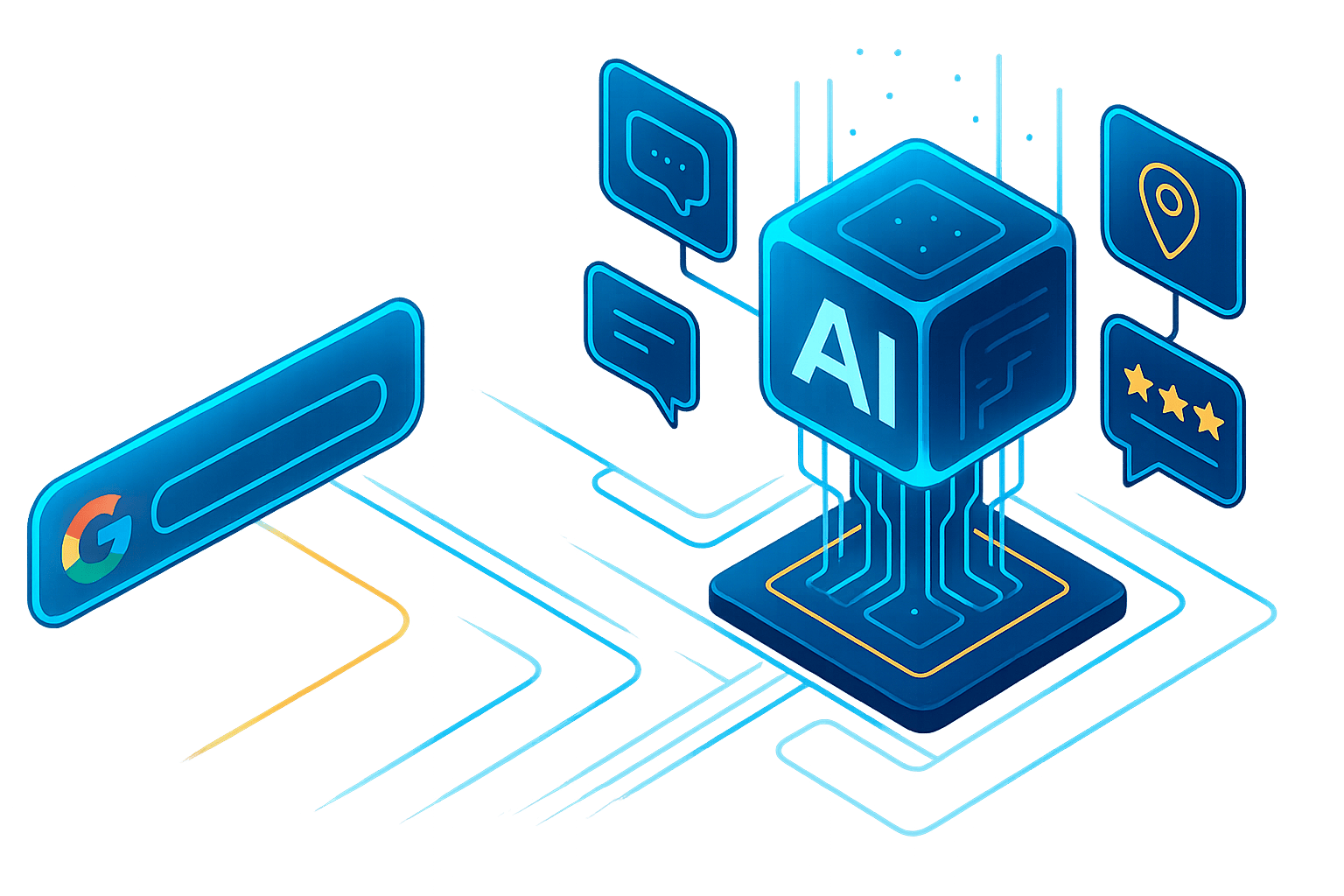
AI SEO refers to how artificial intelligence systems analyze, interpret, and surface information from the web. It explains how search engines and AI assistants process content, entities, and credibility signals.
For local businesses, AI SEO is not the goal.
The goal is Local Answer Engine Optimization (Local AEO), where AI systems decide which businesses to recommend, cite, or summarize when users ask location-based, high-intent questions.
As consumers increasingly ask tools like ChatGPT, Google’s AI Overviews, and other AI assistants who to trust locally, the mechanics of AI SEO become the foundation that powers Local AEO outcomes. This page explains those mechanics. The practical application lives inside Local AEO.
AI SEO vs. Traditional SEO: The Shift in Strategy
This shift explains why traditional SEO alone no longer produces local dominance without Local AEO. Local AEO applies these mechanics to real-world location-based decisions.
| Aspect | Traditional SEO | AI SEO / LLM Optimization |
| Primary Goal | Rank in the “Top 10” blue links | Become the “Verified Answer” in an AI response |
| Ranking Signals | Backlinks and keyword frequency | Factual clarity, entity authority, and structured data |
| Content Style | Long-form, keyword-stuffed blogs | Conversational Q&A and “Direct-to-Answer” prose |
| Data Sources | Primarily your website | Ecosystem-wide (reviews, Reddit, social, directories) |
| Measurement | Impressions and CTR | AI Citation Share and Brand Mentions |
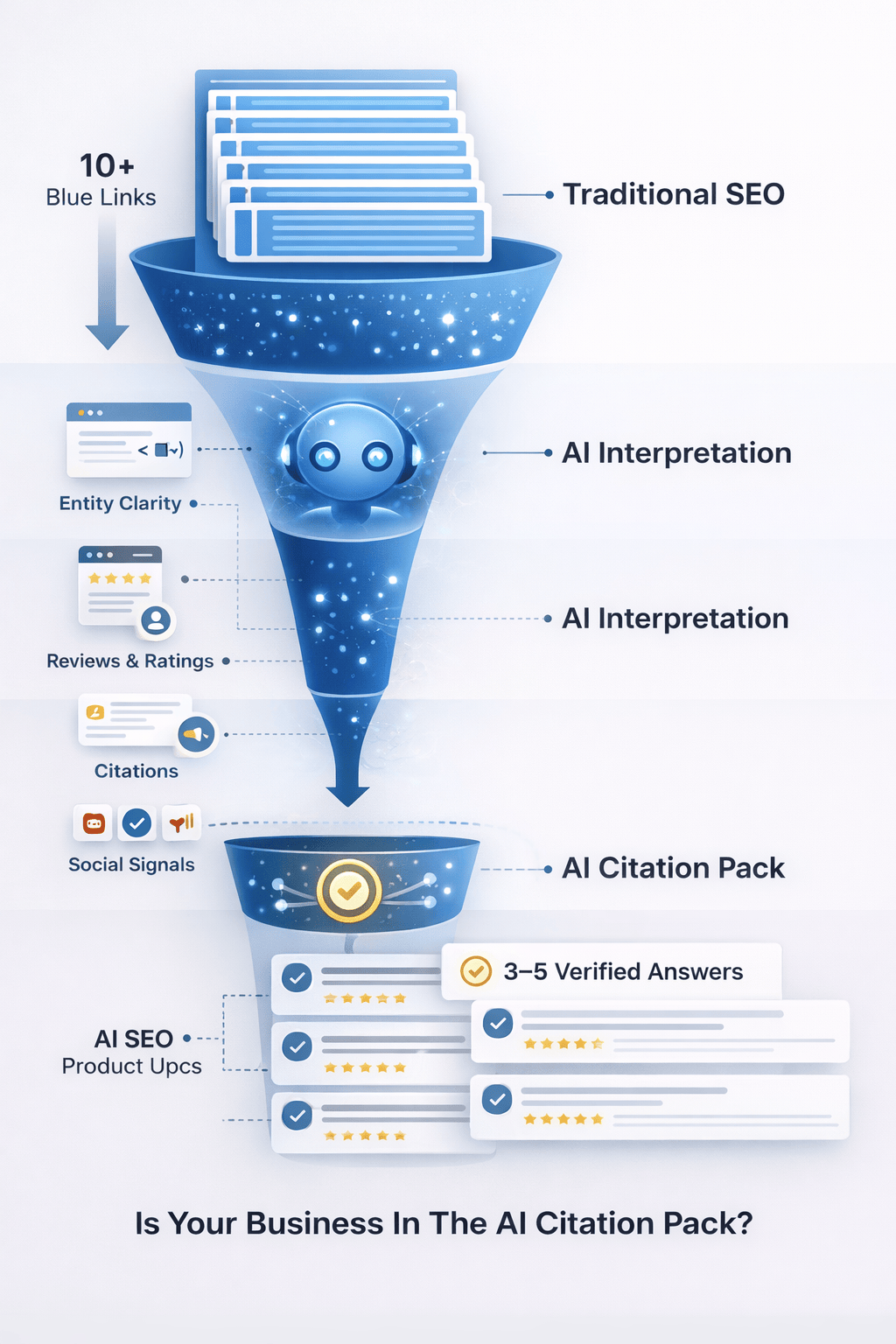
Traditional SEO gets your website ranked in a sea of blue links. AI SEO gets your business shortlisted.
Think of it this way: Google traditionally showed ten links per page. In the new era, AI assistants like ChatGPT, Perplexity, and Google’s AI Overviews typically synthesize an answer and cite a specific “Citation Pack” of 3–5 top-tier recommendations. If you aren’t optimized to appear in that primary “Carousel” or “Sources” list, you aren’t just on page two, you’re effectively invisible. In AI search, the “winner-take-most” effect is even more aggressive than it was on Google.
How AI Systems Evaluate Local Businesses (AI SEO Mechanics)
You can’t game an LLM (Large Language Model) with old-school tricks. Visibility now rests on three specific pillars:
1. Entity Recognition
AI assistants don’t "browse" your site; they parse it for entities. They are looking to connect your business name to specific services and locations with 100% certainty. An LLM audit isn't about keywords, it’s about perception. Does ChatGPT "know" you are an expert in probate law, or does it just think you're a general attorney? If the AI gets confused, it skips you.
2. Conversational Content & Advanced Schema
AI models are trained on dialogue. This means your content needs to stop sounding like a textbook and start sounding like a conversation. Instead of a generic post on "HVAC Tips," you need content that mirrors the literal questions people ask their phones, like “Why is my AC making a clicking sound but not turning on?” Furthermore, you must use Schema Markup (JSON-LD) as a translator. It tells the AI exactly where your price list, service area, and customer ratings are so it doesn't have to "guess" while generating an answer.
3. The Trust Ecosystem (Citations)
AI models are terrified of "hallucinating" (lying). To stay safe, they only recommend businesses they can verify across multiple "trust points." This includes:
Aggressively consistent NAP (Name, Address, Phone) data.
Sentiment-rich reviews on third-party sites (Yelp, GBP, Industry-specific hubs).
Mentions in "unfiltered" spaces like Reddit or local forums that AI models use to gauge real-world reputation.
Adapt or Become Invisible
You’ll hear a lot of acronyms soon: AEO (Answer Engine Optimization) and GEO (Generative Engine Optimization). At SwiftAISEO, we don’t care about the jargon; we care about the result.
Whether it’s a voice search on a Siri-enabled device or a complex research task in Claude, the goal is the same: Your business must be the answer. The window for “getting in early” is closing. Those who’s tructure their data today will be the “verified authorities” of tomorrow.
Ready to see where you stand?
Frequently Asked Questions
1. Is traditional SEO dead?
Not at all. Think of traditional SEO as the foundation of your house and AI SEO as the smart technology inside. You still need a fast, well-structured website to rank on Google, but you now need Entity Mapping and Schema to ensure AI models like ChatGPT and Claude can “read” and recommend you.
2. What is the difference between a “Click” and a “Mention”?
Traditional SEO focuses on getting a user to click a blue link to visit your site. AI SEO focuses on getting the AI to say your brand name out loud (or in text) as the recommended solution. In 2026, many users get their answers directly from the AI without ever clicking a link. If you aren’t the Mentioned brand, you lose the lead before they even see your website.
3. How do you measure success if people aren’t clicking as much?
We’ve shifted our KPIs to match the modern landscape. We track Share of Model (SoM)—how often your brand is cited by major LLMs compared to your competitors—and Sentiment Analysis to ensure the AI describes your business as a trusted authority.
4. Can’t I just use ChatGPT to write my own “AI SEO” content?
You can, but that’s like asking a calculator to teach you math. Using AI to write generic content actually hurts your visibility because LLMs are trained to prioritize “Information Gain” (new, unique insights) over recycled AI text. Our strategy focuses on technical infrastructure (Schema) and “Question-First” data that AI models use as their primary sources.
5. How long does it take to see results in AI search?
AI models “learn” in cycles. While Google updates daily, LLMs (like ChatGPT or Claude) update their knowledge base periodically. Typically, our clients see a shift in “Citation Share” within 45 to 90 days as we update their Trust Ecosystem and technical Schema.
6. Does this work for local businesses, or just tech companies?
It’s actually more critical for local businesses. When a user asks their car or phone, “Where’s the best pediatric dentist in Denver?” they aren’t looking at a list of 10 sites. They are listening to the 1 or 2 names the AI chooses to trust. We ensure you are one of those names.