

The Quick Take (AEO Summary): Google’s AI (Search Generative Experience and Gemini) uses Google Business Profiles (GBP) as its primary source of ground truth for local businesses. To rank in AI answers, businesses must move beyond basic contact info and treat their profile as a structured data asset that feeds the Knowledge Graph.
I’ve seen a clear pattern emerging across local search data over the last year, and it’s one every business owner should pay attention to. The way we “search” has fundamentally shifted.
Google is no longer just a list of links. It’s an answer engine. Between AI Overviews (the generative boxes at the top of the search results) and Gemini (Google’s conversational AI), Google increasingly answers questions without requiring users to click a website.
Here’s the detail most people miss: Google’s AI isn’t hallucinating these answers. It’s grounding them in a massive knowledge base of verified facts. For local businesses, those facts come primarily from your Google Business Profile (GBP).
The Engine Room: Query Fan-Out and the Knowledge Graph
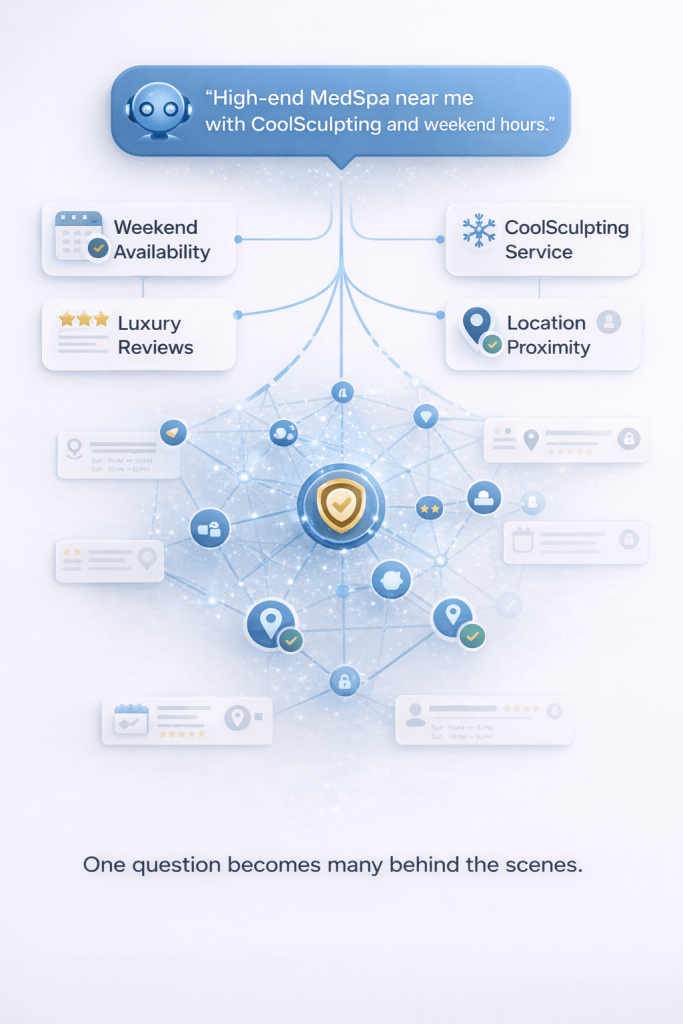
To understand why your profile now matters more than your website in many searches, you need to understand a technical process called query fan-out.
When a user asks a complex question like:
“Where is a high-end MedSpa near me that specializes in CoolSculpting and has weekend hours?”
Google doesn’t answer one question. It breaks that query into multiple smaller questions behind the scenes and runs them simultaneously against its Knowledge Graph. That means your GBP determines whether you are even considered.
- Is the business open on Saturday or Sunday?
- Is “CoolSculpting” listed as a verified service?
- Do customer reviews reference a high-end or luxury experience?
If a service, attribute, or signal isn’t structured inside your profile, it effectively doesn’t exist to the model. Google won’t guess. It will simply move on to a competitor who has provided the data it needs to feel confident.
Your New Homepage and the Zero-Click Reality
Industry studies estimate that nearly 69% of searches now end without a click to a website. This zero-click reality means that for most prospects, your Google Business Profile isn’t just a listing. It is your homepage.
When Google generates an AI answer about a local business, it often reuses or summarizes text directly from that profile. In this environment, your website still matters, but its role has shifted. It’s now a deep-dive resource for motivated users, while your GBP acts as the salesperson doing the heavy lifting directly inside the search results.
If your profile is thin or outdated, you’re effectively invisible on the busiest street in town.
Patterns of Success Across Industries
Across dozens of industries, the businesses that consistently surface in AI-driven search share one trait: structured depth. They don’t rely on clever copy. They rely on complete, explicit data.
HVAC and Home Services
Speed and availability win. When a furnace fails at 2 a.m., the AI needs to see “24/7 Emergency Service” listed as a structured service. If that information lives only in a paragraph on your About page, the model often skips you entirely.
MedSpas and Aesthetic Clinics
This is a battle of specificity. AI grounding depends on explicit treatment tags like Botox, Hydrafacial, or CoolSculpting, paired with high-quality, categorized photos. Google’s AI can analyze images to confirm cues like professionalism and luxury.
Estate and Probate Law
Authority matters most. AI assistants favor firms with rich Knowledge Graph signals, such as defined probate categories, years in practice, and consistent review language around complex estates. These signals outweigh flashy branding.
What AI Will Never Trust From Your Website Alone
A common question is: “If this information is already on my website, why duplicate it in GBP?” The answer is trust and structure.
While Google can crawl websites, it treats many on-page claims with lower confidence than verified profile data. Inside a Google Business Profile, three signals carry disproportionate weight:
Verified Attributes
Tags like “Online Appointments” or “Wheelchair Accessible” are treated as confirmed facts in GBP, not marketing claims.
Review Sentiment
Google’s AI reads reviews contextually. When a client writes, “The probate process was seamless,” that language becomes a factual signal about your expertise.
Real-Time Freshness
Recent GBP activity carries more truth weight than static website content. A post from last week often outranks a page last updated months ago.
Making Your Profile AI-Ready
The goal isn’t to game the system. It’s to become the most helpful, data-rich version of your business.
Complete Every Field
Leave nothing blank. Use highly specific categories and fill even minor attributes like payment methods or accessibility. Every empty field is a missed opportunity for the AI to understand you.
Use Natural, Intentional Language
Write service descriptions the way customers ask questions. Replace vague labels like “Legal Solutions” with clear phrases like “Help with divorce filings and child custody.”
Manage the Content of Reviews
Don’t just chase five stars. Encourage reviews that naturally mention specific services and outcomes. Those details become the citations Google uses to justify its AI answers.
The Bottom Line
We’re entering an era where visibility isn’t about ranking number one on a list. It’s about being the chosen answer.
Google’s AI is a hungry engine, and data is its fuel. If you don’t provide clear structure, the model will choose a competitor who did. The math is simple: if your Google Business Profile can’t explain what you do in plain language, Google’s AI will choose someone who can.