The Ad Spend Trap: Why MedSpas Are Paying More for Google Ads and Getting Less
Your MedSpa's Google Ads bill went up. Your leads went down. Here's why AI search is changing how patients find clinics and what to do about it.
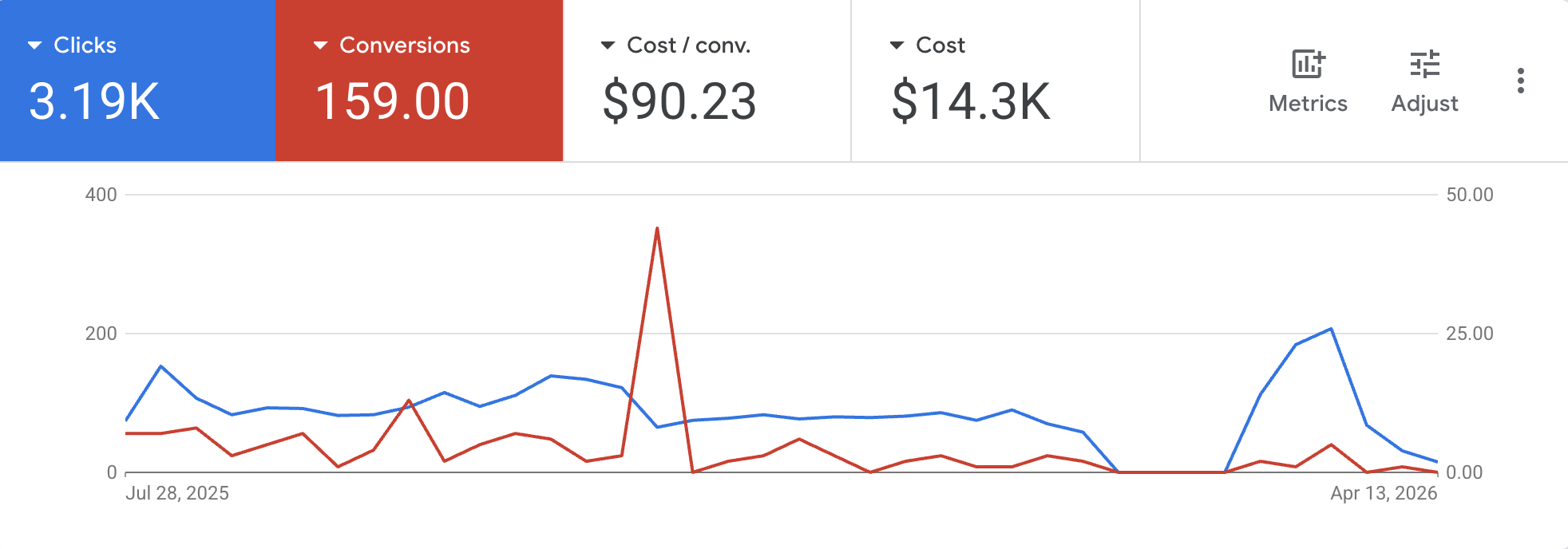
Your Google Ads bill went up 40% last year. Your cost per lead climbed with it. And somewhere across town, a clinic you've never worried about just got recommended by ChatGPT to 50 people asking about Botox.
They spent $0 on ads.
This isn't a hypothetical. It's happening to MedSpas across the country right now, and most marketing directors don't see it coming until the physician-owner is sitting across the desk asking why the numbers aren't adding up.
Here's what's actually going on, and what you can do about it.
Why the Math Stopped Working
Google Ads costs in the aesthetics space have risen significantly. Average CPCs for treatment-related terms have climbed while click-through rates have dropped, because Google itself now answers the question before the patient ever reaches your ad.
According to Semrush data from 2025, 83% of searches that trigger AI Overviews end without a click to any website. On Google's newer AI Mode, that number jumps to 93%.
Your ad may be showing. The patient may never click.
The search behavior hasn't disappeared. The conversion point has just moved somewhere you're not tracking.
Where Patients Are Actually Going
Here's the patient journey that's becoming standard in 2026:
- They ask ChatGPT or Perplexity: "What's the best MedSpa for Botox in [city] with a Board-Certified Aesthetic Nurse Specialist?"
- They get a recommendation: two or three clinics, with specific reasons why.
- They cross-reference on Google, check reviews, and call.
The Google step still happens. But the decision is largely made before it.
According to BrightLocal's 2026 Local Consumer Review Survey, 45% of consumers now use AI tools to find local services. One year earlier, that number was 6%.
That's not gradual adoption. That's a wave that arrived while most MedSpas were still optimizing ad copy.
If your clinic isn't named in step one, the AI recommendation, you're not in the consideration set. You never get to step three.

The Two Budgets You're Running (And One Is Invisible)
Most MedSpa marketing teams are managing two budgets simultaneously, but only tracking one.
Budget 1: Paid visibility. Google Ads, Meta, Instagram. You know what this costs down to the cent. You can pull the report anytime.
Budget 2: AI visibility. How prominently and accurately your clinic appears when someone asks ChatGPT, Perplexity, or Google AI to recommend you. You're probably investing $0 here. And it shows.
The problem isn't that paid advertising doesn't work. It's that paid advertising is now competing with a channel that doesn't charge per click, rewards structured authority signals, and influences patients before they ever open Google.
An independent MedSpa that has properly structured its content, including provider credentials, treatment Q&A pages, consistent directory listings, and review depth, can appear in AI recommendations consistently. For free. Before a $40 Google Ad click ever fires.
What AI Search Actually Needs From Your Clinic
This is where most MedSpas lose ground to Ideal Image and SkinSpirit, not because of budget, but because of structure.
AI models like ChatGPT don't read your website the way a human does. They scan for specific, verifiable entities: people, credentials, procedures, places. They build confidence in a recommendation when those entities appear consistently across multiple sources.
Here's what that looks like in practice:
- Who is the injector? Not just "licensed injector." The more specific the entity, the more citable the claim. "Sarah Chen, Certified Aesthetic Nurse Specialist (CANS), RN, 12 years of practice, specializing in neuromodulators and hyaluronic acid filler for periorbital rejuvenation" is an entity AI can parse, verify, and recommend. A generic bio is not.
- What do they treat? Service-specific pages, not bundled "treatments" pages. Each procedure, including Botox, Dysport, Sculptra, and RF microneedling, should have its own structured page that names the technique, the provider credential required, and the patient outcome.
- What do patients say? Review text with specific procedure and provider mentions. "Dr. Kim's technique with cannula filler placement eliminated my bruising" gives AI a named entity linked to a named outcome. A 5-star rating with no text does not.
- Is the information consistent? Your clinic name, address, and phone number matched exactly across Google, Yelp, Healthgrades, RealSelf, Zocdoc, and every directory you're listed in. Mismatched listings split your entity signal: AI treats them as different clinics.
- Do trusted sources mention you? More on this below.
Entity Hooking in Practice: The phrase "licensed injector" tells AI almost nothing. "Board-Certified Aesthetic Nurse Specialist (CANS) with Fellowship training in facial anatomy" is a recognized medical entity. AI engines assign it to a specific expertise tier. When a patient asks for "an expert Botox provider near me," that entity pulls your clinic into the answer.
Your Google Business Profile alone isn't enough. As we covered in Why Your Google Business Profile Is Not Enough for AI Search, GBP and AI search speak different languages. A perfectly optimized GBP can still leave you invisible in ChatGPT.
This isn't about producing more content. It's about structuring what you already have so AI can read it, trust it, and cite it.
The Signal Most MedSpas Are Missing: Citation Mining
Here's how AI engines build confidence in a recommendation. When ChatGPT sees the same claim, say, "Luminary Aesthetics specializes in PRF treatments for hair restoration," appearing on your website, in a local magazine feature, on RealSelf, and in a "Best MedSpas in [City]" roundup, it doesn't treat these as redundant. It treats them as consensus.
Consensus equals confidence. Confidence equals citation.
This is what's known as a Verifiable Fact Signal: the mechanism behind why Digital PR has quietly become one of the most powerful AI visibility levers available to independent clinics.
What counts as a Verifiable Fact Signal:
- A local news outlet covering your clinic's opening, expansion, or expertise ("Austin's only clinic offering [procedure] with a Fellowship-trained injector")
- A "Best of [City]" list that names your clinic in a specific category
- A feature in an aesthetics or wellness publication (Allure, NewBeauty, local lifestyle magazines)
- A quoted expert comment from your physician-owner or lead injector in a health article
- A directory listing that mirrors your website's exact service and credential language
A single backlink from a high-DA site used to be the goal. In 2026, the goal is cross-source consistency of a specific, named claim. AI engines don't just look for who links to you. They look for who talks about you, what they say, and whether multiple independent sources agree.
The practical implication: Pitching local media, submitting to "Best of" awards, and getting your physicians quoted in health journalism isn't a vanity exercise anymore. It's citation infrastructure. Every earned mention where your clinic is named alongside a specific credential, treatment, or outcome makes it more likely AI recommends you, and less likely it recommends the clinic across town who has better Google Ads but no external validation.
The Case for Independent Clinics
Here's the counterintuitive truth: independent MedSpas can out-cite national chains in AI search, and some already are.
Ideal Image has 170+ locations. That's a lot of entity signals. But they're also speaking to a broad, generic audience. When someone asks ChatGPT for "a board-certified injector in [specific city] who specializes in under-eye filler for mature skin," a well-structured independent clinic wins.
AI rewards depth over breadth for specific queries. A provider bio that includes a Certified Aesthetic Nurse Specialist (CANS) designation, a Fellowship in Advanced Facial Anatomy, and documented patient outcomes is more citable than a chain's generic location page.
Here's what that looks like in practice. Consider a boutique MedSpa, call them Revive Aesthetics, a single-location clinic in a mid-size market. Their lead injector, a board-certified RN with CANS certification and 11 years of practice, specialized in cannula technique for natural-looking under-eye filler. That specificity was embedded in her bio, in treatment Q&A pages, in review responses, and in a local wellness magazine feature that called her "the go-to injector for periorbital rejuvenation in the region."
When patients began asking ChatGPT "who does the best under-eye filler in [city] without bruising," Revive Aesthetics started appearing, not because they outspent anyone, but because ChatGPT could trace a consistent, named claim across multiple independent sources: the clinic's website, the magazine article, Healthgrades reviews mentioning the cannula technique specifically, and a RealSelf Q&A where the injector had answered patient questions in her own name.
The Brand-to-Answer link was explicit: Revive Aesthetics + cannula under-eye technique + minimal bruising. AI connected the brand to the benefit because the content made that connection undeniable.
Over 120 days, the clinic reduced its Google Ads spend by 30% while maintaining lead volume. Patients who called mentioned they'd "seen the clinic recommended" in an AI response. They arrived more educated, more decided, and faster to book, because AI had already done the selling.
See the full entity-building playbook for independent MedSpas.
A Phased Approach (Not "Stop Your Ads Tomorrow")
This isn't about shutting off paid spend cold turkey. It's about diversifying where your authority comes from, before you're forced to.
Months 1 to 2: Foundation
- Run the $0 AI visibility audit to benchmark where your clinic stands in ChatGPT, Perplexity, and Google AI today.
- Audit your NAP consistency across all directories. Mismatched listings actively hurt your AI visibility.
- Build out one complete provider bio with credentials, certifications, and procedure specialties structured for AI extraction, not just web design.
Month 3: Content Restructure
- Create individual Q&A pages for your top 5 treatments. Not marketing copy: patient-question format. "What should I expect from my first Botox appointment?"
- Add FAQ schema markup to these pages so AI can parse and cite them.
- Identify 2 to 3 trusted local or industry publications for earned media placements.
Months 4 to 6: Track the Shift
- Test your AI mentions monthly. Open ChatGPT, search your city and top treatment. Document what comes up and who's cited.
- Watch for inbound patients who say "I found you on ChatGPT" or "AI recommended you." This is your leading indicator.
- Adjust ad spend as organic AI visibility builds. The goal is a channel mix, not dependency on one.
What Winning Looks Like
The MedSpa marketing directors who will be in the best position 18 months from now are the ones who started building AI visibility before their competitors figured out it was happening.
They're not the ones spending the most on ads. They're the ones whose clinics appear when a patient asks an AI tool for a recommendation, with specific reasons why.
The window is still open. Most MedSpas have never tested whether ChatGPT knows they exist.
Start there. Run the free AI visibility audit and find out exactly where your clinic stands, before you're in the next budget review explaining why leads are down despite a six-figure ad spend.
Frequently Asked Questions
Will AI search replace Google Ads for MedSpas?
Not entirely, at least not immediately. Paid search still drives intent-based traffic, especially for branded and transactional queries. But AI search is changing the discovery phase of the patient journey, and MedSpas that ignore it are ceding that ground to competitors who won't. The smarter play is building AI visibility alongside your paid strategy, not instead of it.
How long does it take for a MedSpa to appear in AI recommendations?
Results vary, but structured content improvements, including provider bios, treatment Q&A pages, schema markup, and NAP consistency, typically begin influencing AI recommendations within 30 to 90 days. This is faster than traditional SEO because AI platforms pull from current data and reward recent, structured content.
Does my Google Business Profile help with AI search?
Partially. GBP is one signal AI uses, but it's far from sufficient on its own. AI systems also draw from your website's structure, third-party citations, review content across multiple platforms, and earned media mentions. A strong GBP is table stakes, not a complete AI search strategy.
What's the difference between AI search optimization and traditional SEO?
Traditional SEO focuses on ranking your pages in a list of search results. AI search optimization, also called Answer Engine Optimization or AEO, focuses on being cited inside the AI-generated answer itself. The goal shifts from "show up in the list" to "be named in the recommendation." The underlying content signals overlap, but the structure and format requirements are different.
Ready to become the answer in AI search?
Start with an AI Visibility Audit. See exactly where you stand and what to fix.
Get Your AI Audit | $197